Press Release
August 25, 2026
Inglewood Council Approves Partnership to Rebuild Historic Downtown and Improve Citywide Mobility
INGLEWOOD, CA. — The Inglewood City Council voted in favor of a public-private partnership that will build the Inglewood Transit Connector’s (ITC) mobility hubs and reenvision the streets of Downtown Inglewood — advancing a solution shaped by robust study, rigorous planning and sustained community input into how this City welcomes visitors on event days while keeping everyday life moving for the people who live here.
Construction begins this fall.
Inglewood has become one of the country’s premier destinations for sports and entertainment. More than 60 major annual events at SoFi Stadium, the Intuit Dome, Kia Forum and other venues in the City’s sports and entertainment district bring tens of thousands of visitors into a City of roughly 100,000 residents on a regular basis. Residents have asked the City for a lasting way to move that volume of people, and the ITC Program has been designed to deliver exactly that — capacity built to cut congestion on event days and support everyday trips alike.
“Inglewood has proven what can be accomplished when we set our sights high,” said Mayor James T. Butts, Jr. “This agreement caps our cost, and construction is funded through a partnership with the State and Metro — using grant dollars we competed for and won, and not a dime from the General Fund. When the world arrives in 2028, Inglewood will have the downtown transit capacity to meet the moment, and our residents will have it long after the world goes home.”
The City has already seen a shuttle and bus-based approach work to handle crowd of significant scale. During the 2026 FIFA World Cup, Metro moved record numbers of fans to and from matches at SoFi Stadium using dedicated bus lanes, signal priority and expanded shuttle service, demonstrating that the same tools now being built into the ITC Program can meaningfully cut event-day gridlock in Inglewood. Dedicated event-day shuttle lanes will run from the north and south of the City to the sports and entertainment district, with synchronized signals giving buses priority through the corridor. Improved commuter shuttle service will be deployed for both every day and event day trips — closing the first/last-mile gap between the Metro K and C Lines and key destinations across the City.
Elevate Inglewood Development Corporation (EIDC) was selected as the Best Value Proposer through a competitive procurement. The consortium is led by Plenary Americas as the developer, with Swinerton as design-build contractor and Walter P. Moore as architect of record.
“This agreement gives Inglewood one contract, one team, one fixed price and one deadline,” said Councilmember Eloy Morales, Jr. “The developer carries the cost and schedule risk, which protects Inglewood taxpayers. This is how we build something that uplifts Downtown Inglewood and keeps it thriving for generations to come.”
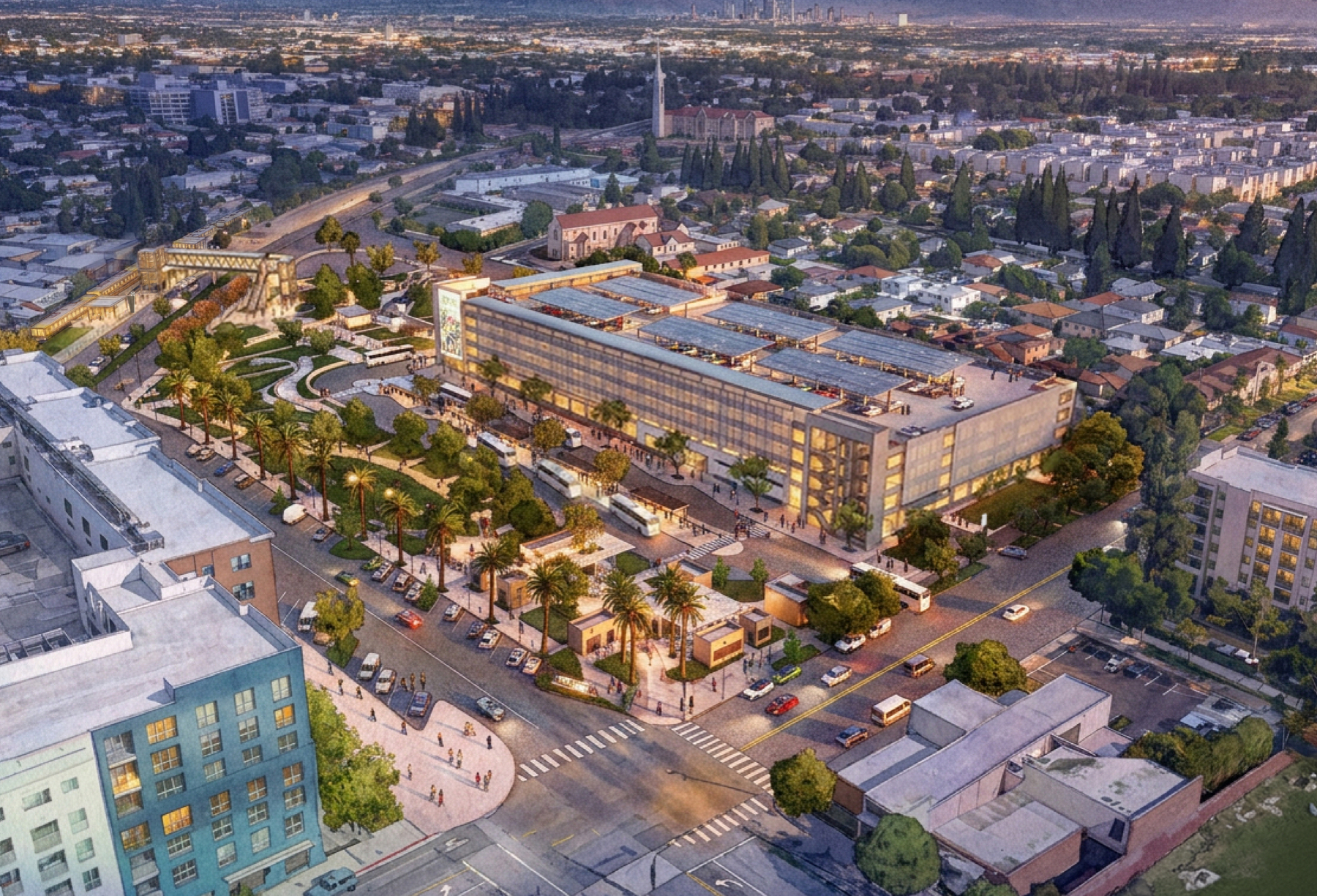
Through the agreement with EIDC, Market Street, Manchester Boulevard and Queen Street will be reenvisioned with new hardscape and landscaping, irrigation, traffic controls, wayfinding, street furniture and pedestrian-scale lighting. Three mobility hubs will be constructed, collectively delivering more than 1,000 new parking stalls, along with a pedestrian bridge over Florence Avenue connecting the downtown core directly to the Metro K Line’s Downtown Inglewood Station. The plan also preserves all necessary right-of-way for a high-capacity automated people mover system in the future.
The largest hub, at Market & Florence, brings transit-oriented retail, parking, a bus plaza and a kiss-and-ride lot to downtown. The work is being coordinated with the City’s Destination Market Street program, which is funding facade and tenant improvements along the same corridor.
“Downtown Inglewood is the heart of this City, and this vote is an investment in it,” said Councilman Alex Padilla. “New sidewalks, lighting and mobility hubs will give our small businesses the foot traffic and the front door they deserve.”
The City is committed to standing alongside the businesses and tenants who will relocate as this work moves forward. Relocation advisors have been assigned to work one-on-one with tenants who are being relocated to make way for the Market & Florence Mobility Hub. In addition to facilitating relocation benefits pursuant to State law, the City is offering incentive grants of up to $250,000 to help those businesses reestablish within the downtown core. The goal is straightforward: to see them thrive in a stronger downtown.
The $261 million budget for the design and construction period will be covered entirely by grants from the State of California’s Transit and Intercity Rail Capital Program and from Metro. No General Fund dollars will go into construction, and no new tax is required to build or operate the system.
The project is structured as a Design-Build-Finance-Operate-Maintain agreement, or DBFOM, which places design, construction, financing, operations and maintenance under a single contract with EIDC, at a fixed price against a fixed completion date.
Under the agreement, EIDC will operate and maintain the Market & Florence Hub and the pedestrian bridge for 20 years, while the streetscape and the two remaining hubs return to the City upon acceptance. Payments over the operating term are earned against clear performance standards for availability, cleanliness, safety and security, and state of good repair.
“EIDC is excited to partner with the City of Inglewood on this transformative investment in Downtown Inglewood,” said Dale Bonner, Plenary Concessions Executive Chairman. “We commend the City’s leadership for its vision and commitment to delivering infrastructure that will improve mobility, support local businesses and create lasting benefits for the community.”
Building Careers, Not Just a Corridor
The agreement carries a 35% local hiring commitment spanning construction and ongoing operations and maintenance, a goal of 20% local and small business participation, and a Community Workforce Agreement. The City is also working directly with the building trades on apprenticeship readiness and with Inglewood Unified School District (IUSD) on a youth engagement and education program designed to introduce students of all ages to careers in construction and transit before they ever leave high school.
“The Project Labor Agreement is what makes 35% percent local hire real — it sets the wage floor, the benefit standard and the apprenticeship structure that turn a job into a trade. I want Inglewood residents in those apprenticeships and Inglewood businesses winning these subcontracts,” said Councilwoman Dionne Faulk. “I want our young people to see it happen. We are working with Inglewood Unified so a student can walk onto our active construction site in their own neighborhood and understand there are multiple paths forward to high wage careers in the construction industry.”
City analysis projects that the ITC Program will generate approximately $210 million in tax revenue, $1.5 billion in total economic output, and support hundreds of jobs for Inglewood residents and workers across Los Angeles County over the life of construction and operations.
“A project this size is only as good as the careers it leaves behind,” said Councilmember Gloria Gray. “This agreement requires a Community Workforce Agreement, apprenticeship readiness, and training pathways. With a 20-year operating term, these jobs do not vanish when the barricades come down.”
WHAT TO EXPECT
Beginning in November, roadway work will occur primarily at night, with mobility hub construction during the day. Market Street, Manchester Boulevard and Queen Street will be rebuilt block by block, each block taking roughly two months. Business access will be maintained throughout, and adjacent businesses and the public will receive advance notice before activities begin. As with any project of this scale, there will be periods of temporary lane closures, sidewalk detours, parking adjustments, construction activity and modified traffic patterns, and the City will keep the community informed every step of the way.
Other Phase 1 elements are moving on separate tracks. Lot T at Prairie and Manchester is complete and served as a flexible event space during the 2026 World Cup. Design of the event-day bus lanes and the Intelligent Transportation Systems program are advancing under separate City contracts, with construction anticipated to begin in 2027.
The project team will continue sharing information through the ITC website, the ITC Updates e-newsletter and the project’s social channels, and will work directly with property owners, tenants and affected businesses on site-specific needs.
Residents, business owners, employees and visitors are encouraged to stay engaged through community meetings, workshops, surveys and the project website. Information is available at www.inglewoodtransitconnector.com.
ABOUT THE INGLEWOOD TRANSIT CONNECTOR
The Inglewood Transit Connector links Downtown Inglewood and the Metro K and C Lines to the City’s sports and entertainment district. Phase 1 delivers mobility hubs, dedicated event-day bus lanes, streetscape improvements and intelligent transportation systems, with right-of-way preserved at Market and Manchester for a future automated people mover. All design and construction grant funding for Phase 1 is secured.